
Blog
Blog
SEO in the AI era: how to get the most out of it!

Evie van Rooij
Search marketeer
Published
30 October 2026
Reading time
15 min read
“SEO is dead and ‘zero-click results’ dominate the new Google landscape. So nobody visits my website any more”.
You've no doubt come across claims as dramatic as this. I'm not going to say nothing is happening or that AI isn't changing anything, but I do want to put statements like this into perspective and give them some context. Because it really isn't as dramatic as it's sometimes made out to be.
Remember?
When voice search was the next big thing? Nobody would type a search query any more. You absolutely had to reach number 1, because that was the only answer that would be read out. And with the rise of Featured Snippets, hardly anyone would click through to your website. Did that actually happen? Not in my experience.
Back then, too, the predictions for organisations and websites were so dramatic. Fortunately, it all turned out fine. Yes, the number of clicks dropped slightly with the rise of Featured Snippets, and voice search was only partly taken up by the masses.
- Voice search was, and still is, mainly used to control devices, not so much to carry out full searches on Google.
- In the end, the rise of voice search led to a loss of around 6% of clicks – and that drop only applied to the #1 position in Google.
- In the end, Featured Snippets turned out not to be zero-click results as such. Almost 40% of search results with a Featured Snippet still result in a click.
Of course the rise of voice search and Featured Snippets had an impact, but did it have as much impact as predicted? No, certainly not. I'd like to give you that same context when it comes to the rise of AI and zero-click searches and results.
The market share of AI results
Worldwide, Google's market share remains well above that of AI tools such as ChatGPT. To give you an idea:
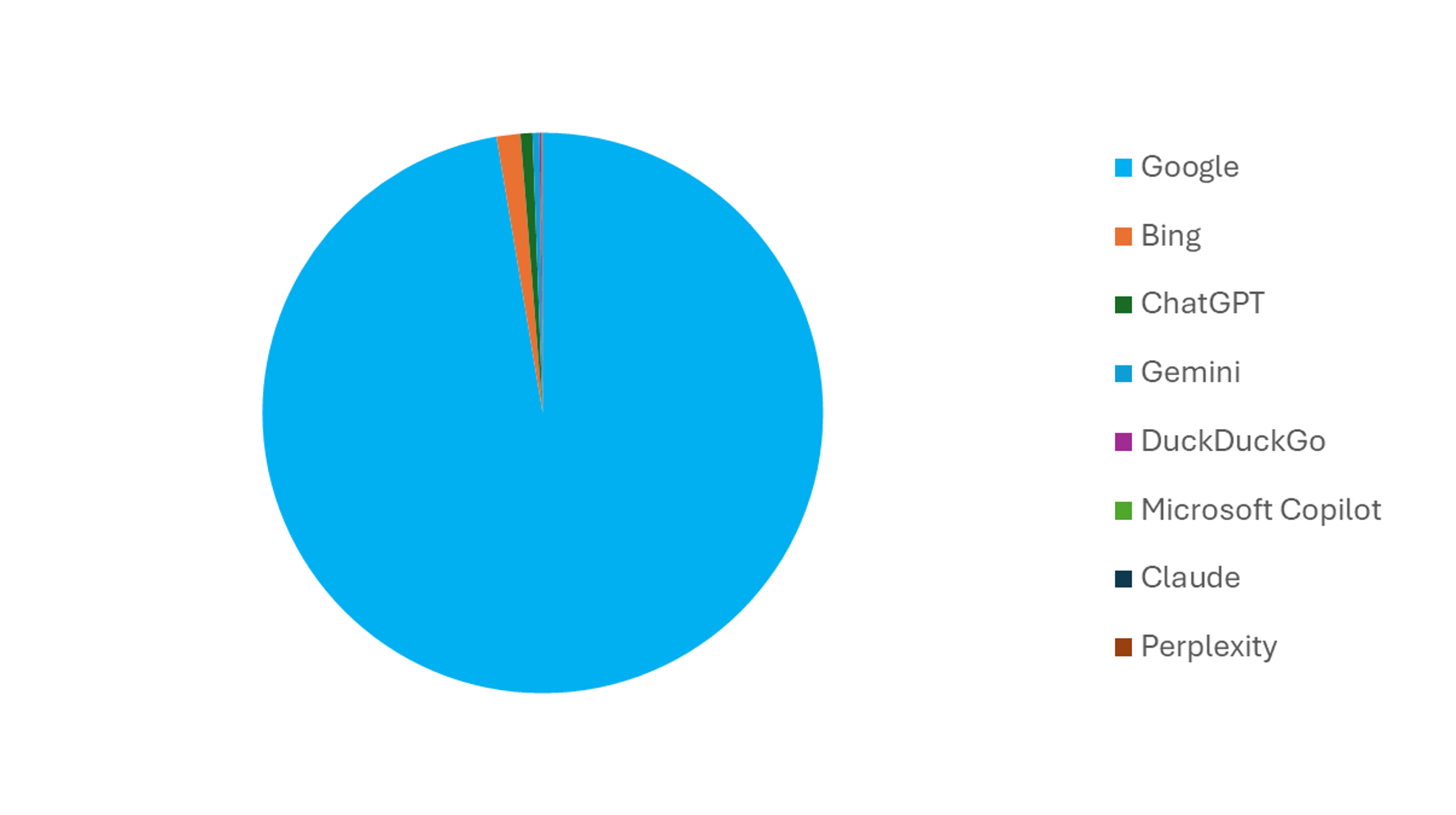
Of course, AI Overviews in Google do change the situation somewhat. A few facts:
- Since mid-May, AI Overviews have been shown in the Netherlands.
- Initially only for informational queries (in around 5% of cases).
- Later in May and early June, this share rose to around 27%, with the focus still on informational queries, but AI Overviews were also increasingly shown for more commercial queries.
- This share is expected to fall back to around 10% - 15% in future (based on data from the US).
- Of course, this depends heavily on the type of query (informational vs. transactional).
So that means AI Overviews affect around 15% of your organic traffic. And in most cases we see a shift from search results with a Featured Snippet to search results with an AI Overview, whose share is currently also around 10% - 15%.
A new zero-click result, then, replacing an old zero-click result. A small caveat is that the chance of a zero click is higher with an AI Overview than with a Featured Snippet. But we're also already seeing that a result with an AI Overview currently leads to a new, follow-up search more often than a Featured Snippet does.
And what's the advantage for you? If you weren't winning the Featured Snippet, the chances are now much higher that you will appear in the AI Overview. The AI Overview shows information from multiple sources, which increases your chance of visibility. In general, Google takes the information from the content of the top 5 results in Google. I should add, though, that if you did hold the Featured Snippet, you unfortunately make room for the competition in the AI Overview, precisely because more sources are shown.
What does this mean for your SEO strategy?
Even though the share and impact of AI are smaller than expected, we shouldn't just sit back and watch what it does to our traffic. Whenever something changes in the search landscape, you should always take a critical look at your own strategy. Are you still working on the right things? Or should your focus shift a little?
And to know whether you're working on the right things, it's important to understand how AI tools such as ChatGPT work. And also how Google actually decides which answer is given in its AI Overview.
How do AI tools such as ChatGPT arrive at their answers?
AI tools such as ChatGPT were initially trained on an enormous dataset of books, websites and other sources. That dataset was updated with data up to 2023, with a smaller data update in June 2024. Based on this dataset, the AI tool learns to give answers, make connections and construct sentences. To then give you the right and most up-to-date answer, the tool can also use a search engine itself to find the answer.
So if you ask (for example) ChatGPT a question, it first starts from its own dataset. If it's a question where recent data matters for the answer, or you specifically ask for it, the tool can search the internet using an external search engine to find the answer. ChatGPT itself says this is usually Bing, but in practice the information more often turns out to come from the Google index.
The AI tool then combines what it learned from the training data and, where relevant, its research on the internet to formulate the best answer. ChatGPT itself says that the free app can't search live internet data, but in practice this varies a great deal, and for a large share of accounts you can see that it is possible and does happen.
In addition to training data and information accessible through search engines, ChatGPT has also struck various partnerships with news platforms (mainly in the US), from which it also draws a lot of recent information.
Also good to know:
- So AI tools such as ChatGPT don't crawl and index the internet themselves the way a search engine such as Google or Bing does.
- ChatGPT has started crawling and indexing websites itself (as an experiment), but only on a very limited scale. It's quite possible this will grow in future.
- These AI tools therefore depend heavily on public search data, such as the SERPs of Google and Bing
- If ChatGPT gives an answer without searching the internet, that information is most likely based on information from before October 2023 – or before June 2024.
- AI tools formulate the answer themselves, so it isn't always correct, even when they use information that is.
- Because AI tools give an answer based on training data, they also look at more sources than just your website.
- Just like Google, ChatGPT also looks at user history and will give you an answer based on your previous interactions with ChatGPT.
And how does that work for Google's AI Overview?
To give the right answer in the AI Overview, Google naturally uses information from the websites that Googlebot has crawled and indexed – from the Google index. So the way the answer in the AI Overview is determined isn't really different from how it 'normally' happens. The biggest difference from the 'regular' search results is that Google uses AI to take information from different websites and formulate the answer itself.
As a result, information from your website may be combined with information from another website, allowing Google to formulate its own answer. The sources of the data are, however, always shown with each part of the answer, and as an overall source for the answer as a whole.
Also good to know:
- Because Google formulates the answer itself based on different data sources, the answer may be wrong. You can flag incorrect answers with the feedback button, which Google can then learn from.
- Google takes your search history and your interaction with the search results into account and adjusts the AI Overview answer accordingly. If you often click on another result when an AI Overview is shown, Google may factor this into its decision on whether or not to show an AI Overview for your next search
- Google wants the searcher to stay within Google as much as possible, so it will do everything it can to answer all questions within the SERP.
- It isn't yet possible to interact with the AI Overview in the Netherlands, but this will probably come in future.
And last, but certainly not least!
Research in the US shows that traffic reaching your website through an AI search converts 4.5 times better than your 'regular' organic visitors. So although there are fewer of them, they have already researched your brand and services more thoroughly, which significantly increases the chance of conversion. Thanks to all the information they've already gathered about your brand and service through AI, they're closer to a purchasing decision. A nice advantage, then!
What does this mean for my SEO strategy? Or GEO strategy?
Even though the impact is still relatively small at the moment, that doesn't mean you can simply sit back and watch what happens to your website visitors. We don't yet know exactly where the integration and use of AI are heading. But we do know it isn't going away any time soon. So action is definitely needed, both now and to prepare for the future!
Fortunately, you're already doing a lot right if you're currently using a modern SEO strategy. You've probably come across the term GEO too: “Generative Engine Optimization”. This is an SEO strategy in which you focus on optimising for AI tools. However, it's a very limited view of SEO, especially if you assume that AI (as it is used today) is a phase. In future, AI will probably be built into and used in everything, making it part of everything. So you'll no longer optimise specifically for AI – but for the various tools and channels in which AI is built.
A GEO strategy shrinks your SEO vision considerably. At Partout, we believe in a 360 (or omnichannel) approach, in which you use SEO for all the tools that serve as a search engine or answer engine. So not just for Google, but also for TikTok and YouTube. And therefore also for AI tools such as ChatGPT and Gemini.
Search 360 SEO strategy
In a 360 SEO strategy, you decide up front which channels matter to you. We do this by analysing how your audience searches and where your audience is, and therefore where they go looking for answers and information. Instead of optimising for search engines alone, we optimise for people who search – wherever they do it. Via Google, AI tools, YouTube, podcasts, TikTok and even internal search engines.
Based on this, you can make a channel selection with the channels where your audience is active. That channel selection sets the conditions and ground rules for your SEO strategy. Curious how we determine this together with you? Then we can carry out a 360 Search Scan for you, so you'll know:
- How your audience searches
- At every stage of the customer journey (stages of awareness)
- Which channels your audience searches on
- And which questions they ask on which channel
- How findable you already are on these channels
- And where opportunities still lie
- How you can become more findable on these channels
- What the potential is across all the selected channels
- And what growth you can expect
The channels on which your audience is active and the needs they have determine your SEO strategy. But a few channels will always be part of your SEO strategy, including Google and AI. And that, of course, is exactly what this article is about.
So how do you take AI into account in your SEO strategy?
AI isn't going away and will therefore always be part of your SEO strategy from now on. That does change the rules of the game somewhat, but fortunately the basics largely stay the same.
On the one hand, because the AI Overviews belong to Google, and Google has been working towards them for years. And on the other, because ChatGPT (and similar tools) also use search engines themselves to access live information on the internet.
What should you pay extra attention to in your SEO strategy so that it also (or especially?) performs well for AI? Both for AI Overviews in Google and for AI tools such as ChatGPT.
- E-E-A-T: Experience, Expertise, Authoritativeness, Trustworthiness
- E-E-A-T is a way Google assesses the quality of search results. And in AI tools especially, it's important that the answer is correct, because the margin of error there is larger than with 'regular' search results. So make sure your content on every channel proves that you or your company has experience with the subject you write about, that you are the expert and authority in that field, and that you are a trustworthy partner.
- Helpful content & NLP models
- The searches people carry out and the questions they ask AI tools are, for now, almost all informational queries. So make sure you put extra focus on helpful content in your SEO strategy: content that offers information and genuinely helps the searcher. Write this helpful content with a focus on NLP (Natural Language Processing) models: that is, the way questions are (naturally) asked of AI tools and the way the answer is then formulated. Divide it into easily separable sections.
- Optimising for entities
- Entities are used by both Google and AI tools. You can think of entities as a kind of digital neural network that makes connections between different topics, people, things and organisations. This means you need to be present on different channels (Search 360), make connections between your organisation and your employees (for example with ABM), work on getting reviews (for example with Google or UGC) and mark up content correctly (structured data) for the best understanding.
- Structured data (schema.org)
- With schema.org, you can add extra information to content so search engines and AI tools better understand what the content is about. This can be interesting for products (Product), FAQ pages (FAQPage), step-by-step articles (HowTo), organisations (Organization) and events (Event), for example. It also helps form entities, and therefore the understanding Google and AI tools have of your content and organisation.
- Bullet points, enumerations and lists
- AI tools and AI Overviews love lists! Because they often pull information from different sources, lists are an easy way for them to scan information and pick out what they need to formulate the right answer. So use lists and bullet points (in moderation) in your content to structure information clearly and break up sub-topics and answers.
- How-to and step-by-step articles
- This is really an extension of lists and enumerations: articles in which you explain a topic in a step-by-step or how-to format. This kind of content is great for AI tools, because they can extract summaries of the whole process from it, as well as information on each individual step – so specific questions can be answered quickly and well too. That way, the information from your one article can be used to answer different questions.
- Online PR & branding
- Online PR and branding matter for several reasons. AI models are trained on large datasets in which they look at entities and connections. When your brand is mentioned in the right context on different channels, AI tools can make connections more easily and will be quicker to see you as the authority. If, in addition, your brand is written about by, for example, industry associations, AI can better understand what your brand stands for and therefore link you more easily to a particular service or industry. Online presence and reputation are a strong signal for AI tools and search engines.
- User Generated Content (UGC)
- Brand mentions and positive sentiment are important for AI tools. So work on them consistently with user-generated content, possibly in collaboration with influencers. It's important to consider different types of platforms here, because AI pulls information from various platforms and quantity matters! Along with positive sentiment, of course.
- Trends & fresh content
- AI (and search engines) love 'fresh' content because they like to give the searcher the most up-to-date answers. So make sure you keep up with relevant trends and write about them in good time, so your content is always up to date, relevant and recent. This can also mean updating older content.
- Be concrete and avoid vague, generic language
- AI loves clear language and facts backed up by data and figures. AI tools are already good at vague, generic language themselves, so make sure you're concrete, specific and factual in your answers and explanations. That way they can easily pull the right facts from your content.
Don't get distracted by the hype. Yes, AI is important. Yes, AI is changing a lot. But a lot also stays the same. Focus above all on being findable in the places that matter to your audience, and at the right moments. Need help making your SEO strategy AI-proof? We're happy to think along with you! Shall we give you a call?
We are Partout
We are a B2B marketing agency in Eindhoven. We make sure B2B companies land on the shortlist of their ideal customers, especially in complex buying processes where others get stuck. We combine branding and demand generation so you become a brand in demand. Instead of just chasing leads, we build a brand that is seen, trusted and chosen.