
Blog
Blog
Structured data for better visibility in search engines

Evie van Rooij
Search marketeer
Published
30 October 2026
Reading time
15 min read
You've probably heard of structured data, but what exactly is it? What can you do with it? And what does it actually have to do with SEO and search engines? Here we give you all the ins and outs. We also give you a number of ready-made examples you can get started with yourself!
What is structured data?
Structured data is a script you add to a page's HTML, usually in the head or the body. It gives specific elements extra context, so Google better understands what the page is about and what certain parts are for. The result? Your answer can be shown more clearly and in more detail in the search results. That gives your result more visibility and, if all goes well, leaves less room for the competition.
Ideally, a structured data script is written in JSON-LD, following the Schema.org method. Schema.org is a joint project of the largest search engines, aimed at developing a uniform language that all search engines can work with. Because Schema.org is open source, it is constantly evolving. New forms of structured data are added all the time, and search engines are quick to adopt them. For them, it's an ideal way to find out extra information about a web page.
What's in it for me?
A lot! If you apply structured data correctly, your search results stand out more visually in the search engines. The search engine can then show so-called rich results for your page, adding extra information to the search result, for example in the form of review stars, prices or stock levels.

What types of rich results are there?
Rich results are extra additions to Google's search results page, also known as the SERP (Search Engine Results Page). With structured data, you can trigger many different types of rich results. Which rich results are relevant depends on your website, services or products. So it's smart to implement only the structured data that's genuinely useful to you. That way, your effort translates directly into more visibility and better results.
Carousel
A carousel always appears above the first organic search results. So this is definitely where you want to be shown! You see carousels for recipes, products, local search results and films, for example. By combining carousel structured data with the right structured data for your type of content, you increase the chance that your content appears in such a carousel too. You're then literally positioned above the organic results, and that's a spot you want to win!

Featured snippet
A featured snippet also appears above the first organic search results. Landing one is a lot harder than landing other rich results, though. Structured data doesn't really play a role here. Even so, we mention it because it is a visible and valuable spot in the search results.
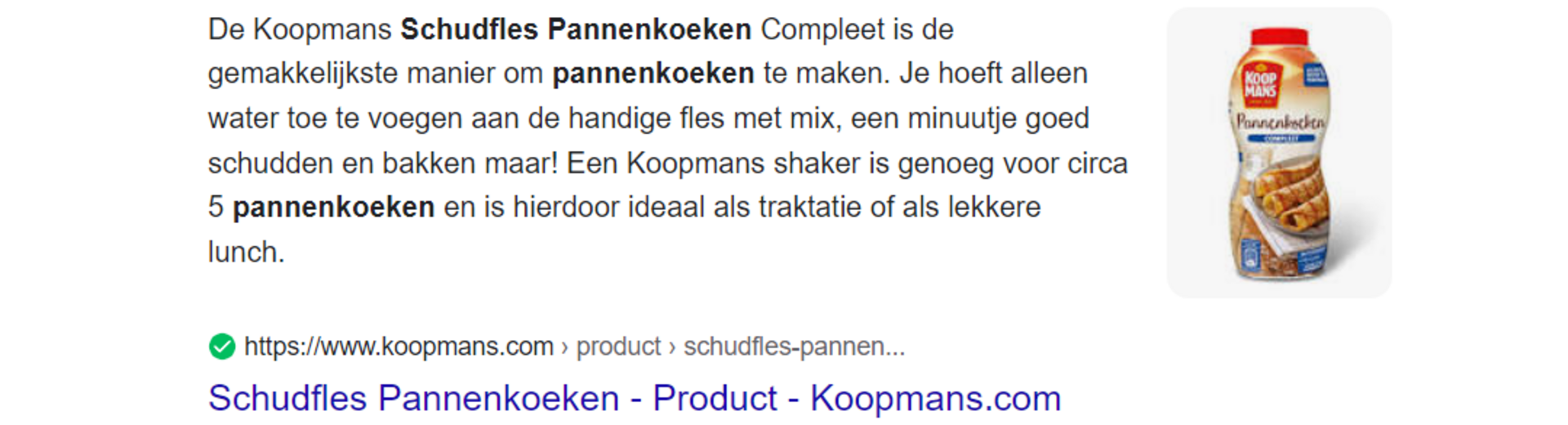
Review stars
Review stars stand out — and that's exactly their strength. They draw attention in the search results and boost your credibility before anyone even clicks through. Good ratings immediately show that you're reliable and that customers are happy with your product or service. An effective form of social proof, right in the SERP.
Frequently asked questions
Don't just answer frequently asked questions on your page; support them with FAQ structured data too. That increases your visibility in the search results: the questions and answers appear directly below your search result. That way, you take up more space on the page and literally push competitors down. Especially interesting if you're already in the top 3, because then you can really dominate the view.

Indented search results
With indented search results, you essentially get two or more listings for the price of one. If a search query has several angles and your page answers them all, Google may decide to show several results from your site one below the other. Unfortunately, structured data plays no role here; it's all about content: offer a complete answer to every aspect of the search query.
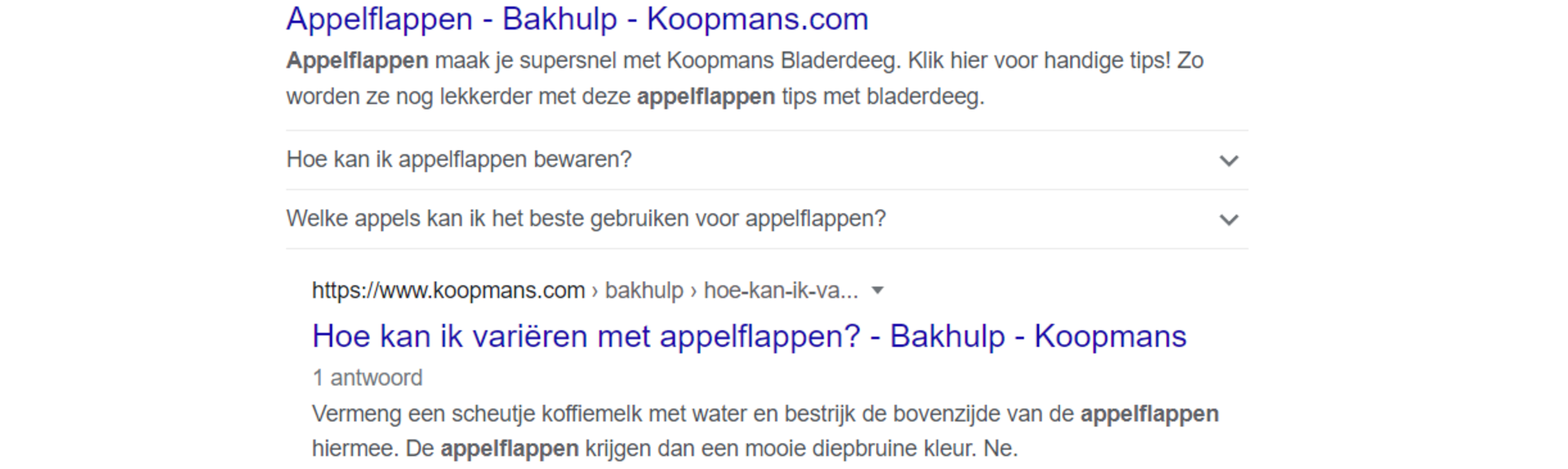
Structured data can, however, strengthen other parts of your search result. Think of extra information, or an image or video shown directly. For each form of structured data, we explain the effect it has in the search results and how you can use it yourself.
Different types of structured data
To activate different rich results, you need different types of structured data. Because there are plenty of applications, we explain the most commonly used variants below, including what they do and how to use them.
Breadcrumbs
Breadcrumbs show where a page sits within your website's structure. Handy for visitors and for search engines. You often see them on websites themselves, but with structured data you can make them appear in the search results too.
Note: the breadcrumb path doesn't have to follow the URL structure exactly. In fact, you ideally leave out the less meaningful parts, such as the main domain or technical tags. That keeps it clear and relevant, for both users and Google.
What is the benefit of breadcrumb structured data?
On the one hand, you help search engines better understand your website's structure — which can benefit the visibility of important pages. At the same time, you increase your presence in the search results, which can improve your click-through rate.
For visitors, breadcrumbs make it easier to see where they are within your site. They can easily navigate to higher levels without relying on the back button. And that's exactly what you want: keeping users on your own website instead of sending them back to Google.
FAQ
With FAQ structured data, you clearly mark which answers belong to which questions, so Google properly understands how your content is structured. But more importantly, you increase the chance that those questions and answers are shown directly below your search result. That brings not only extra visibility, but also more space in the search results.
What is the benefit of FAQ structured data?
The biggest benefit is that you get a much larger search result than competitors who don't use FAQ structured data. If you're among the top results on the page, it's an easy way to push your competitors further down. You can also tease searchers with your answers, which increases the chance they'll click through. A good opportunity for more visitors, in other words!
FAQ structured data can also get you an action on the Google Home assistant. If someone asks the Google Home assistant a relevant question, one of the answers from your FAQ structured data can be read out as the answer.
Note! According to Google's guidelines, FAQ structured data is intended for genuine FAQ pages, meaning pages that consist primarily of frequently asked questions and their answers. If you use this markup on a different kind of page, you run the risk of Google seeing it as misleading or even as spam.
Even so, in practice FAQ structured data is often applied to regular pages too, to become visible in the search results with a few questions and answers about the topic. You're free to do that, as long as you know Google can decide at any moment to stop allowing it. You then run the risk of losing your rich result, even if your structured data is technically correct.
Logo structured data
With logo structured data, you indicate which brand mark is your organisation's official logo. Google then better understands which image belongs to your brand and can show this logo in the knowledge panel, together with other information about your organisation. You pass on that additional information, such as name, address or contact details, with organization structured data.
What is the benefit of logo structured data?
With logo structured data, Google actively links your logo to your brand name. When people search for your company, the logo can become visible in the search results, increasing visual recognition. That way, logo markup strengthens your online brand identity and contributes to consistent branding in the search environment.
Product
With product structured data, you give Google extra information about your product and the context around it. Think of the product description, stock status, price, ratings and images. All these details can be shown directly in the search results. For example, the price, a star rating or an 'in stock' notice appears right below your search result, which creates more visibility and trust among potential buyers.
What is the benefit of product structured data?
With product structured data, you can show the most important information about your product directly in the search results. Think of the price, availability and customer ratings. Are you one of the cheapest providers? Then your sharp price catches the eye straight away. Does the product have high review scores? Then those five stars immediately stand out to potential buyers.
Research carefully which unique features make your product stand out on the site and make use of them in your structured data. The more you stand out, the greater the chance that searchers click through. At this stage of the buying process, that often means extra conversions.
Organization
With organization structured data, you mark up your organisation's key company details. Google can then use this information to display in the knowledge panel for searches for your brand. You can add your social media channels, address, phone number and other contact details, among other things. That way, you ensure a complete and reliable profile in the search results.
What is the benefit of organization structured data?
By using organization structured data, Google can fill your company's knowledge panel with all the key company details. So when someone searches for your company name, they immediately see all the important information. This makes it easier for visitors to get in touch with your company.
Sitelinks search box
With sitelinks search box structured data, you mark up your website's search function so that it becomes directly visible in the search results. This lets users search within your site straight from Google or Bing. That shortens the route to the right page and makes it easier for visitors to quickly find what they're looking for.
What is the benefit of sitelinks search box structured data?
The sitelinks search box is especially valuable for large online shops with a strong brand name. When people search for your brand through a search engine, they can use the search box to search for a specific product directly within your website. The big advantage? You help visitors find what they're looking for faster and send them straight to the right page.
Note! A sitelinks search box requires a well-functioning internal search function on your website. As soon as someone runs a search through Google, you naturally want that person to land straight on the right page within your site. Does your search function not work properly? Then the search box does more harm than good.
Video structured data
Search engines struggle to properly understand the content of a video. Video structured data helps by providing additional information, such as a description, the duration and the publication date. Thanks to this markup, your video can appear in the regular search results, but also in the video and image tabs.
You can also mark important parts of your video as key moments. Google then shows these directly in the search results. Although Google also tries to recognise key moments automatically, the moments marked in your structured data take precedence. That way, you stay in control of what gets highlighted.
What is the benefit of video structured data?
With video structured data, you increase the chance that your video is shown in the regular search results and in the video and image tabs. For searches where a video is a logical or desirable answer, you stand out with a visual, attractive display. A smart way to create extra visibility and draw more clicks to your content.
Job posting
Every organisation has vacancies sooner or later, and then of course you want them to stand out in the search results. Job posting structured data helps with that. Since 2021, Google Jobs has also been available in the Netherlands: a separate job search engine within the search results. By applying job posting markup, you increase the chance that your vacancies appear there directly and attractively.
What is the benefit of job posting structured data?
With job posting markup, you increase the visibility of your vacancies in exactly the place where potential candidates are actively looking for a new job. Not only in the regular search results, where it's hard to stand out, but also in Google Jobs — an extra job search engine within Google itself.
Do you also publish your vacancies on external platforms? Then there's a good chance they also use job posting structured data. Your vacancy may then appear several times in Google Jobs, which considerably increases your visibility and reach.
Local business
With local business structured data, you mark up your company's local details, such as opening hours, address, contact information and reviews. Google can then show this information directly in the search results and on Google Maps. It's a valuable addition to your Google Business Profile and increases your visibility in the region.
If you use this structured data smartly, you can even appear in carousels for local businesses, complete with the details you've marked up yourself.
What is the benefit of local business structured data?
By using local business structured data, you're visible with the right information at the right moment. Is someone looking for an online marketing agency in Eindhoven, for example? Then it's rather handy if they have your opening hours and contact details right at hand.
Other forms of structured data
Aggregated rating
With aggregated rating, you mark up ratings of a product or of your company, so ratings are shown directly in the search results with review stars. You can use aggregated rating in combination with organization or product structured data. You can only use aggregated rating if you actually collect reviews. You can do this through an external platform or on your own platform.
What is the benefit of aggregated rating structured data?
The well-known review stars in the search results play an important role in how people make choices. In a world where social proof is becoming ever more decisive, potential customers almost always look at ratings first. Positive reviews can immediately strengthen trust and make it much easier for someone to go ahead with a purchase or get in touch. The stars in the search results remove an initial doubt before anyone even visits your website.
Points to note when using aggregated rating
The aggregated rating markup is intended as a rating of either your organisation or a specific product. Adding your company's rating? Then it belongs on the homepage. Product ratings go on the relevant product page. That keeps your structured data clear and in line with Google's guidelines.
How do you implement structured data?
Google recommends implementing structured data in JSON-LD. This is not only the most recent standard, but also the easiest way to add structured data to your website. You simply place the code in the HTML, preferably in the head of the page.
No access to the source code or the CMS? Then you can also add structured data through Google Tag Manager. That way, you still keep control over your markup without having to tinker with the website itself.
Creating a structured data script
Fortunately, you don't have to write a structured data script from scratch. There are plenty of examples and handy tools that make it easier. With this schema generator, you simply choose the type of markup, fill in the required details, and the tool automatically generates the right code.
You can usually take the variables straight from the page or the website. After that, it's just a matter of checking that your code is correct, for example with Google's Rich Results Test.
Testing structured data
You can also easily test whether your code is correct and check whether the page has the right markup after implementation. Google has its own tool for this, but you can also use the tool from schema.org. We prefer the schema.org validator, because it lets you find any errors in your code straight away. Google's tool only tells you whether the markup has been implemented and will therefore be displayed in the SERP.
Structured data is expected to become even more important in the future. Google may support more existing forms of structured data, or new types may be added. So keep a close eye on which forms of structured data add value for your website and target audience.
What does structured data have to do with SEO?
Not that much, really. Structured data isn't a ranking factor, and using it won't suddenly lift you to a higher organic position. Yet structured data does have a lot to do with SEO too. It's a good way to influence how your search result is displayed in the SERP. And the SERP has everything to do with SEO.
Structured data is a good way to keep some control over the search results for your domain, to be visible in more places in the SERP and to take up a larger spot in the search results. Plenty of reasons to invest in structured data!
We are Partout
We are a B2B marketing agency in Eindhoven. We make sure B2B companies land on the shortlist of their ideal customers, especially in complex buying processes where others get stuck. We combine branding and demand generation so you become a brand in demand. Instead of just chasing leads, we build a brand that is seen, trusted and chosen.