Blog
Blog
How to create a B2B buyer persona of your ideal customer

Meike Cremers
Digital marketing Consultant
Published
30 October 2026
Reading time
13 min read
In B2B you rarely sell to one person. Behind every purchase is a group of people who decide together, each with their own role, interest and concerns. If you lump them all together, you create content and messages that don’t really resonate with anyone.
A buyer persona helps you truly understand those people. It’s a profile of your buyer, built on research rather than assumptions. That way you know who you’re talking to, what’s on their mind and how they make a decision.
In this article we explain what a B2B buyer persona is, walk you through how it relates to your ICP and your DMU, and show you how to create one step by step. We use a concrete example to show what such a profile looks like in practice. By the end, you’ll have a clear picture of how to get from a vague idea of your buyer to a usable profile that sharpens your content and sales.
One caveat up front: a buyer persona doesn’t stand on its own. It builds on your ideal customer and your ICP, and it only becomes meaningful when you actually use it to steer your content and conversations. We’ll come back to this later, but keep it in mind as you read.
What is a B2B buyer persona?
A B2B buyer persona is a research-based profile of a typical decision-maker or influencer within your ideal customer. It’s a fictional but realistic character who represents a group of real buyers. This buyer persona is built from what you know about those people. That gives your target audience a face.
A good persona goes beyond demographics. Age, job title and education say little about why someone chooses you. Far more important are the role they play, the goals they pursue, the challenges they run into and the criteria on which they base their decision. That’s where it differs from a classic target audience description. Where a target audience mainly describes who someone is, a persona describes how someone thinks and decides. That shift matters, because buying behaviour tells you much more about how you can help someone than their job profile does.
So a customer persona isn’t a form-filling exercise with a few characteristics, but a working tool. It helps everyone working on content or sales put themselves in the shoes of the person on the other side of the table. What’s more, in B2B you almost always work with several personas at once. An end user and a financial decision-maker look at the same solution very differently, and those are exactly the differences you want to make visible. A single company-wide persona would flatten that nuance. By creating a separate profile for each role, you keep sight of each stakeholder’s own questions and objections.
How do buyer persona, ICP and DMU relate to each other?
Two other terms often come up around the buyer persona: the ICP and the DMU. Many people easily confuse them, even though each describes something different. If you know the difference, you keep your approach sharp and know exactly what a persona is and isn’t about.
In short, you move from company to person. An ICP describes which companies are a fit and a DMU describes the group of people who decide together. A buyer persona zooms in on one of those roles. Below, we briefly explain each term.
Ideal Customer Profile (ICP)
The Ideal Customer Profile describes the type of company that suits you best, with criteria such as industry, size, region and the extent to which an organisation recognises your problem. So the ICP is about accounts, not people. It determines which companies you target. You can read how to put that profile together in our article on defining your ideal customer.
Decision Making Unit (DMU)
Within that ideal customer sits the Decision Making Unit: the group of people who decide on a purchase together. These are often an end user, a manager, a buyer and sometimes an external adviser. Each of them views your offering through a different lens and has a different stake in the choice.
Buyer persona
The buyer persona zooms in on one role within that DMU. You often create several personas, for example one for the end user and one for the decision-maker, because their questions differ so much. That’s how you translate the abstract DMU into concrete people you can address with your content.
So the three terms work like a funnel. Your ICP defines which companies are interesting, the DMU shows who decides together there, and the personas give those decision-makers a face. Each level makes the previous one more concrete, until you know exactly who you’re talking to.
Why do you need a buyer persona in B2B?
B2B purchases work differently from consumer purchases. They are more rational, several stakeholders have a say and the processes take a long time. Impulse purchases barely exist. Instead, there’s a process lasting weeks to months in which different people become involved.
Without a sharp picture of those people, you create content that doesn’t really resonate with anyone. You end up writing for an abstract audience, and the result is often so generic that it doesn’t stick with anyone. A persona forces you to get specific: who are you writing for, and which problem are you solving for them?
That makes the buyer persona the foundation of your entire approach. Your content addresses real questions, your message strikes the right chord and your sales conversations start with understanding instead of a sales pitch. You address the right person at the right moment.
The effect reaches beyond marketing alone. When marketing and sales share the same picture of the buyer, their efforts reinforce each other instead of running in parallel. That makes the whole customer journey smoother.
A persona also helps you make choices. Creating content takes time, and without a sharp picture of your buyer it’s tempting to write about all sorts of things. With a clear persona you can ask of every idea whether it really helps your buyer move forward. That stops you spreading your energy across topics nobody in your target audience cares about.
How to create a B2B buyer persona step by step
The biggest pitfall is filling in a profile based on assumptions, while the real insights lie with your customers and your own team. A strong buyer persona is therefore based on research, not on what you think you know. Importantly, it’s not just about who your buyer is, but above all about how they make their purchase. The buying process is the heart of a good persona. The following six steps will get you started.
1. Gather data from desk research and your CRM: Start with what you already have. Your CRM, website analytics and previous customer conversations often hold more information than you think. Map out who your current customers are, what positions your contacts hold and which questions keep coming up. That forms the basis for the rest.
2. Conduct customer and sales interviews: The most valuable insights come from conversations. Interview a number of existing customers about their choice: what problems did they run into, what tipped the balance and what doubts did they have? Talk to your sales colleagues too, because they hear every day what’s going on with prospects. These conversations reveal the deeper motives that no dataset shows.
3. Define the roles within the DMU: Map out which people are involved in a purchase and what role they play. Who uses the solution, who decides on the budget and who can block the purchase? By naming those roles, you know how many personas you need and which ones.
4. Map out goals, challenges and decision criteria: For each role, work out what that person wants to achieve, what they run into and what they base their choice on. What makes their job easier, and what holds them back? This layer makes the difference between a superficial profile and a persona you can really build content on.
5. Analyse the buying process stage by stage: Look at how your buyer moves through their purchase, from first realising there’s a problem to the final choice. What questions do they have at each stage, and what information are they looking for then? Once you know that, you can create content that helps them at every step instead of ambushing them with an offer. This step is the heart of your persona and also the one most often skipped. Many profiles stop at who someone is, while it’s precisely the path to purchase that tells you where your content can make the difference. So take your time here.
6. Capture the persona in a usable profile: Bring everything together in a clear profile that your team actually uses. Give the persona a name and a face, and summarise their role, goals, challenges and buying behaviour in one overview. Make sure the document is easy to share, because a persona that ends up in a drawer achieves nothing.
Example: B2B buyer persona
An example makes it concrete. Imagine a company that sells production planning software. One of their most important personas is the operations manager of a mid-sized manufacturing company. We’ll call him Operations Olaf.
Olaf is responsible for day-to-day production and is judged on efficiency and delivery times. His goal is a smoothly running schedule without surprises. His biggest challenge is that he currently works with outdated systems and separate spreadsheets, which lead to errors and delays. He feels pressure from above to improve production, but has little time to get to grips with new systems.
Reliability and ease of use weigh heavily in his decision. Olaf wants proof that a solution works at companies like his, and he’s wary of a long, complicated implementation. He doesn’t decide alone: the board focuses on the investment and the IT department on the technology. His research often starts online, where he reads articles and looks for examples from similar companies, before he even gets in touch.
With a profile like this, the whole team suddenly knows who it’s working for. The content can address Olaf’s fear of a difficult implementation, and sales can start the conversation from his need for proof. Want to work this out yourself? Then you can use a fill-in template to capture your own personas step by step.
Bear in mind that this is just one persona. For the same company you would also create a profile of the director who keeps an eye on the investment and of the IT lead who looks at the technology. Together they form the DMU, and only once you know those different perspectives can you create content that brings the whole buying team along.
How do you translate your persona into a Point of View and content pillars?
A buyer persona only becomes valuable when you use it to steer your content. A profile you create and then forget changes nothing. The real work begins when you translate the insights from the persona into the topics you communicate about.
That starts with your Point of View: your own take on the problem your persona is grappling with. Based on the goals and challenges you mapped out, you formulate a position that connects with what’s on your buyer’s mind. Next, you choose a few content pillars, the recurring themes that flow from it and that you keep publishing about.
That way you create content for every stage of the buying process instead of one-off messages. For Olaf, for example, you write about preventing scheduling errors, about what an implementation realistically involves and about how similar companies made the switch. You can read how to build this in our article on Point of View and content pillars.
What does a buyer persona workshop deliver?
You rarely create a buyer persona alone at your desk. The knowledge you need is spread throughout your organisation: in marketing, but above all with the people who talk to customers every day. Sales, support and account managers know first-hand what’s on prospects’ minds.
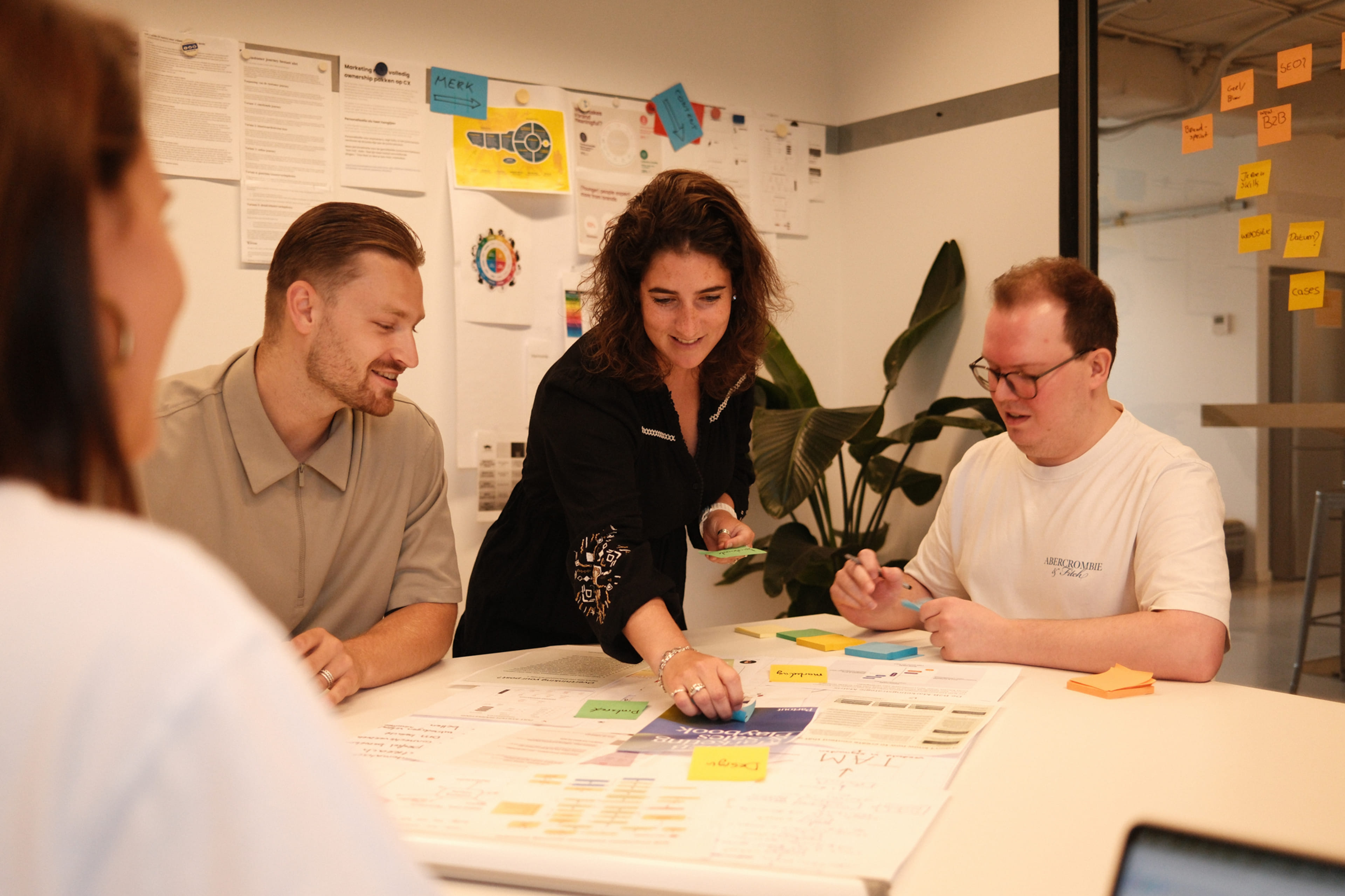
A workshop is the way to bring that knowledge together. By getting the colleagues involved around the table, you combine the data from your research with practical experience from across the organisation. That not only delivers a richer profile, but also makes sure everyone recognises themselves in it. A persona that’s created together actually gets used in practice.
At Partout we regularly facilitate sessions like these. We bring the right people together, ask the questions that bring deeper motives to the surface and translate the outcome into profiles your content and sales teams can put to work straight away.
An added benefit is that such a session often exposes hidden assumptions. It regularly turns out that marketing and sales have a different picture of the same buyer. By putting those side by side in a workshop, you get not only a better profile, but also a shared starting point for working together afterwards.
Common mistakes with buyer personas
A few things often go wrong when creating a buyer persona. They result in a persona that looks good but achieves nothing in practice. Once you know them, they’re easy to avoid. Below are the three we see most often.
The first is a persona that leans too heavily on made-up demographic details. A profile with a nice photo, an age and a hobby looks appealing, but says nothing about why someone buys. Focus on role, goals and buying behaviour instead of invented colour.
The second mistake is a profile that says nothing about the buying process. If your persona only describes who someone is and not how they arrive at a decision, you can’t build content on it. It’s precisely that buying journey that makes a persona usable.
The third mistake is the persona that disappears into a drawer once it’s made. A profile nobody uses is wasted effort. Make sure the persona stays visible, share it with the whole team and update it as soon as the market or your insights change.
What these mistakes have in common is that they turn a persona into a product instead of a tool. A profile isn’t finished when it looks good on paper, but when your team uses it to make better choices every day. Keep that goal in mind and you’ll naturally steer clear of the pitfalls above.
Getting started with your own buyer persona
The ICP tells you which companies are a fit, the persona tells you which people within them to address and how. Together they form the bridge between the ideal customer and the content that convinces them. Without that profile, your content remains guesswork.
The gain lies in its sharpness. When you know exactly what your buyer wants to achieve, what they run into and how they decide, every message hits home and every sales conversation gets easier. You stop broadcasting to an abstract audience and start talking to real people.
Want to create strong buyer personas that genuinely move your content and sales forward? Then get in touch. Together we’ll map out your buyers and translate them into profiles your team works with every day.
We are Partout
We are a B2B marketing agency in Eindhoven. We make sure B2B companies land on the shortlist of their ideal customers, especially in complex buying processes where others get stuck. We combine branding and demand generation so you become a brand in demand. Instead of just chasing leads, we build a brand that is seen, trusted and chosen.